
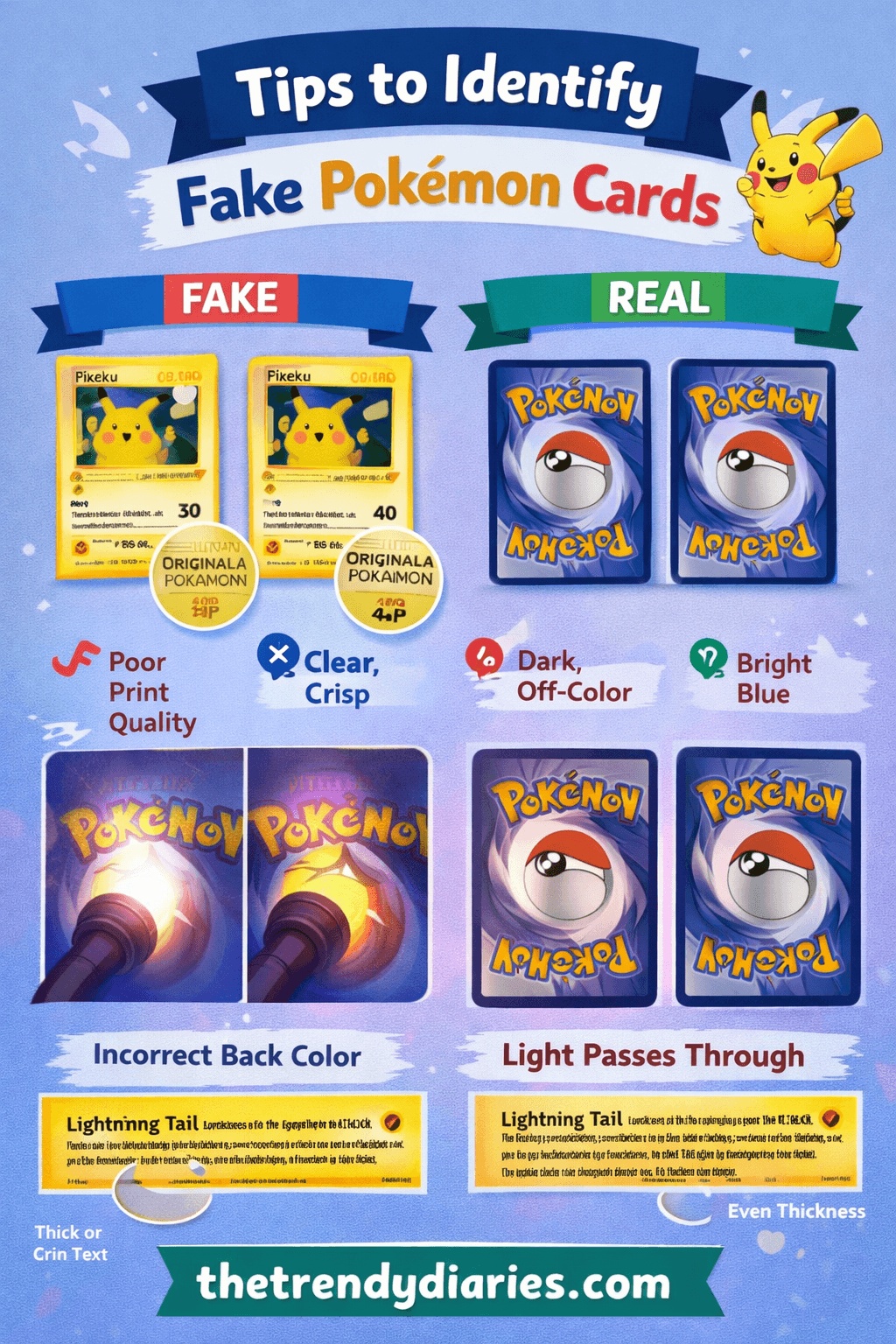
Pokemon cards aren’t only collectibles, they are an international phenomenon that blends trading, gaming and nostalgia. Due to their increasing popularity however the market has witnessed an increase in counterfeit or fake Pokemon cards. Players and collectors need to be on guard to avoid being swindled, since fake Pokemon cards may offer little or no value and can even ruin your collection. Learning to discern counterfeit Pokemon card is vital for all Pokemon fans of all ages.
How to Identify Fake Pokemon Cards
1. Check the Card’s Print Quality
- Genuine Pokemon cards are printed at a high-quality with crisp colors, precise fonts as well as clear and crisp images.
- The design is vibrant and precise, without blurring, pixelation, or blurring.
- Fake cards typically have blurred text, faded colors and images that are not aligned particularly in the character designs as well as energy symbol.
- Pay attention to take a close look at Pokemon emblem and the trademark symbols. Counterfeit cards could have slightly deformed logos, or may be missing (r) symbols.
2. Examine the Card’s Material
- Authentic Pokemon card packs are constructed from premium quality cardboard that has particular thickness and finishing.
- They are coated with a light glossy finish on the front, and a matte, smooth surface at the rear.
- Fake cards are typically made of thin, fragile or too glossy paper. They can bend easily or feel a bit heavy.
- A quick lighting test could aid by holding the card to an intense light. Genuine cards only allow some light, whereas counterfeits can allow light to pass easily because of poor-quality materials.
3. Check the Holographic and Foil Effects
- A variety of uncommon Pokemon cards have foil or holographic designs.
- Genuine foil cards feature a uniform reflective shine that catches light in a uniform way.
- Fake cards usually have sloppy dull or unbalanced effect of holographic.
- The reflection might appear blurred or off-color, that is a clear indicator of counterfeiting.
4. Inspect the Font and Text
- Text on Pokemon cards contains HP attacks, attacking names, damages and even abilities.
- Genuine cards are consistent in size, spacing and alignment.
- Fake cards can contain misspellings, fonts that are inconsistent inconsistencies in grammar, incorrectly placed numbers.
- Be aware of the copyright details at the bottom of the page; authentic cards show “(c) Pokemon / Nintendo or Creatures/ Game FREAK “ clearly.
5. Examine the Card Back
- The reverse of the Pokemon card is a distinct style with a classic Pokeball in the middle along with the name “Pokemon” in large yellow letters.
- Fake cards usually have erroneous colors, blurry borders or an uneven spacing on the reverse.
- A slight difference in hue or shade can suggest a counterfeit.
6. Compare Card Edges and Borders
- Real Pokemon cards have clean, straight edges.
- Fake cards can be rough, uneven, or excessively thick borders.
- Put the card under the light of a bright source and see whether the card bends or reflects light differently along the edges. This can be a sign that you have a fake
7. Use a Reference or Online Database
- Pokemon cards may be checked using official databases or collector websites.
- Check the set number on the card as well as the rarity symbol and edition year to verify authenticity.
- Fake cards might have incorrect set symbols, a wrong year, or lacking indicators of rarity.
Quick Checklist: Real vs Fake Pokemon Cards
| Feature | Genuine Card | Fake Card |
| Print Quality | Sharp, vibrant, detailed | Pixelated, faded, blurred |
| Material | The cardboard is thick and sturdy. | A thin, flimsy, and too glossy |
| Holographic/Foil | Uniform reflective | Patchy, dull, uneven |
| Text | Consistent, no spelling errors | Misspellings, misaligned |
| Card Back | Accurate colors, clear design | Off-color, blurry, uneven borders |
| Edges & Borders | The clean cut Even | Thick, rough, uneven |
Final Thoughts
The identification of counterfeit Pokemon cards requires careful consideration of the quality of printing, the card materials and effect of holographic holograms, accuracy of text as well as the back of the card and edges. Through practice, collectors can quickly recognize counterfeit cards, and avoid expensive errors. Always purchase from reliable sources and verify the card’s data carefully, and if doubtful, check it with authentically-issued cards. Be vigilant and ensure you that the Pokemon collection is valuable authentic, authentic, and stunning.