
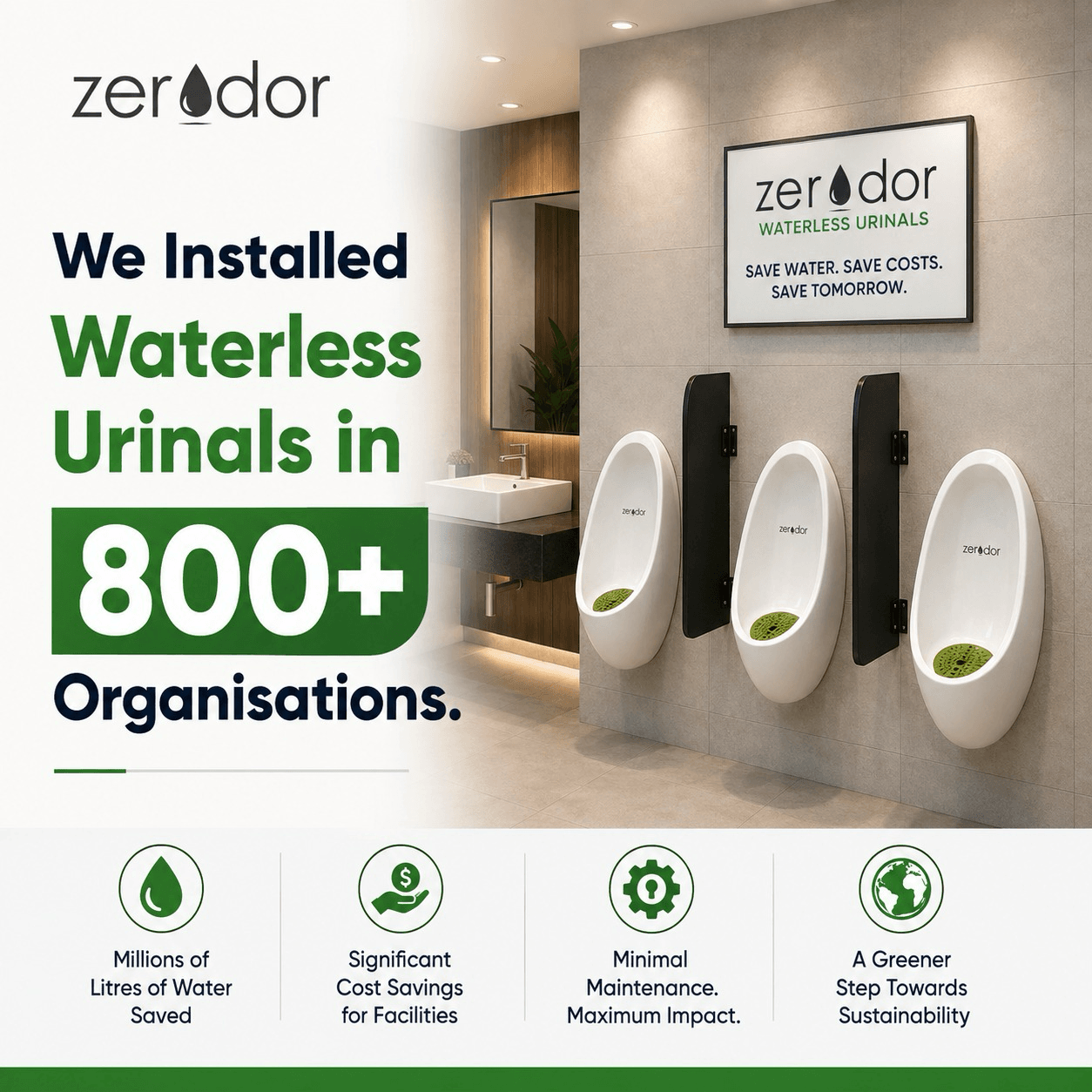
When we first started installing waterless urinals, we thought the biggest conversation would be about water savings. And it made sense. A conventional urinal can use liters of potable water with every flush. Multiply that by hundreds of users, dozens of urinals and 365 days (about 12 months) a year, and the numbers quickly become difficult to ignore. We expected facility managers to care about reducing water bills. We expected sustainability teams to care about conservation. They did. But after installing Zerodor waterless urinals across more than 800+ organizations, we discovered something else: water savings were only the beginning of the story.
The first thing that surprised us was how much of the problem had nothing to do with the urinal itself. It was about everything connected to it. In a commercial building, one flush can feel insignificant. A few liters, and it is done. But facilities do not operate one flush at a time. Airports, malls, hotels, hospitals, factories, schools and corporate campuses can have thousands of people using their washrooms every day. Every flush consumes treated water and creates wastewater that eventually has to be collected, transported, and treated. Suddenly, the equation is no longer simply about flushing. It becomes potable water consumption, wastewater generation, STP load, treatment requirements, energy and maintenance. That made us ask a very basic question- why are we using treated water for a function that does not actually require it?
The second surprise was that facility managers were not looking for another “green product.” They were looking for something that worked. Sustainability may open up a conversation, but it rarely closes a B2B decision on its own. Facility teams have enough to worry about: complaints, maintenance, breakdowns, water bills, consumables, and daily operations. They do not want a solution that looks impressive in an ESG presentation but creates another problem on the ground. They want reliability, predictable maintenance, lower operating costs and measurable impact. That changed how we presented Zerodor. We stopped talking only about the fact that it was waterless and started talking about what happened after installation. Does it work reliably? Does it control odor? Does it reduce consumables? Does it reduce water use and wastewater generation? Does it make life easier for the people actually managing the building?
The third surprise was how closely water and odor are connected to the way a washroom is designed. Anyone who has managed a large facility knows that washroom complaints rarely arrive as technical reports. They arrive as, “There is a bad smell,” or “Please check the urinal.” The traditional response is often more fragrance, more chemicals or more frequent cleaning. But masking an odor is not the same as solving its source. Zerodor approaches the problem differently. Its patented mechanical one-way valve is designed to prevent sewer gases from coming back through the urinal, without relying on oil sealants, cartridges, sensors, or electricity. For us, this is an important part of sustainable design: solving a problem at its source rather than continuously adding something to compensate for it.
Then came the numbers. One waterless urinal saving water is useful. Thousands of waterless urinals saving water is a very different story. A Zerodor urinal can save over 150,000 liters (about 39625.8 gal) of water per year, depending on usage. Today, Zerodor has crossed 85,000+ installations, contributing to more than 3.5 billion liters (about 924602000 gal) of water saved. Those numbers matter to us, but not simply because they make a good headline. They represent water that did not have to be treated, pumped, and transported simply to be flushed away. They also represent a different way of thinking about infrastructure: instead of asking how much water a building needs, we should also be asking how much water the building can avoid using in the first place.
Another thing that surprised us was how often the simplest sustainability solutions can have the biggest operational impact. Sustainable conversation can sometimes make the change sound complicated. Smart buildings, advanced sensors, artificial intelligence, new materials, and increasingly sophisticated technologies all have an important role to play. But sustainability does not always require complexity; do we actually need water for this? If the answer is no, then continuing to use potable water simply because that is how the system has always been designed deserves to be questioned.
We also learned that sustainable infrastructure could change behavior without asking people to change their behavior. We often tell individuals to turn off taps, take shorter showers, and avoid wasting water. Those actions matter, but commercial buildings show us another possibility. Infrastructure can make the sustainable choice automatic. Someone using a waterless urinal does not have to consciously decide to save water. They simply use the facility, and the system does the saving. If sustainability is going to work at the scale required by growing cities and businesses, we cannot depend entirely on millions of people remembering to make the right decision every day. We also need buildings designed so that the better choice becomes the default.
When we started, water conservation was often treated primarily as a cost-saving exercise. Today, businesses are increasingly looking at water through the lens of resilience, ESG, resource efficiency, green buildings, and long-term operational risk. Water is no longer simply another utility expense. For many organizations, it is becoming a strategic resource. As Indian cities grow, commercial infrastructure expands and water demand increases, buildings will have to become significantly more efficient. The question is no longer whether businesses will have to rethink their relationship with water. The question is how early they will begin.
After more than 85,000+ installations, our biggest lesson is that sustainability becomes powerful when it becomes operational. A sustainable idea can sit comfortably inside a report. A sustainability solution must survive Monday morning in a busy building. It must work during peak-hour usage, function when the facility team is stretched, make economic sense, remain easy to maintain and deliver measurable impact. That is what our journey with Zerodor across 800+ organizations has taught us.
The surprising part was never that waterless urinals could save billions of liters of water. We believed in that from the beginning. What surprised us was discovering how many other systems become better when we simply stop using water where water is not necessary. That may be one of the most important lessons for the next generation of sustainable infrastructure. We do not always need a more complicated solution. Sometimes, we simply need to stop doing something that never made sense in the first place.